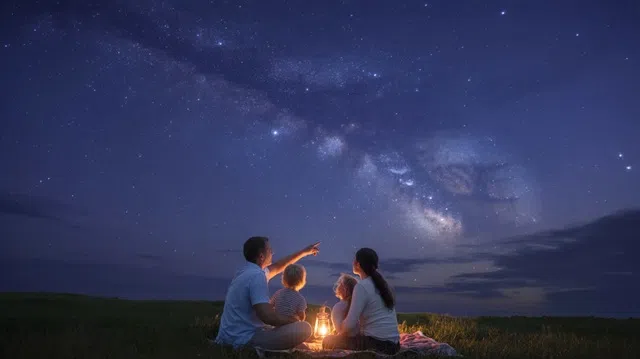
Skywatchers are in for one of the brightest celestial shows of the year as the annual Geminid Meteor Shower reaches its peak late Saturday night into the early hours of Sunday.
Astronomer Gary Boyle, known widely as The Backyard Astronomer, says the Geminids are consistently one of the most spectacular and reliable meteor showers each year.
According to the International Meteor Organization (IMO), the shower may produce up to 120 meteors per hour at its peak.
On paper, this is could be the perfect night to stargaze – if you bundle up.
For anyone who has never watched a meteor shower before, Boyle says the experience is simple-and awe-inspiring.
While meteors can be seen simply by looking at the night sky, Boyle goes over the best strategy for you on Saturday night.
He also recommends going with friends so you can all face in different directions.
Boyle added that you may want to brew some coffee as well if you really want to see the best part of the show.
Boyle notes that the Geminids come from debris left behind by the asteroid 3200 Phaethon, rather than a traditional comet.
The particles burn up as Earth passes through the thickest part of the debris field—always during the same week each December.
The result is a show filled with slow-moving meteors that often appear yellow, green, or white.
Some may even flare into brilliant fireballs, bright enough to momentarily light up the ground.
Jupiter will also be visible in the northeast around 7 p.m. and remain out all night, adding another bright feature to the sky.
Clouds may interfere, but Boyle says light cloud cover won’t completely ruin the view.
And if Saturday night is completely overcast, Sunday night will still offer a chance to catch stragglers—just in smaller numbers.
Boyle stresses that the Geminids are completely safe to watch.
For those hoping to photograph the event, Boyle recommends a DSLR camera on a tripod, set to a long exposure.